

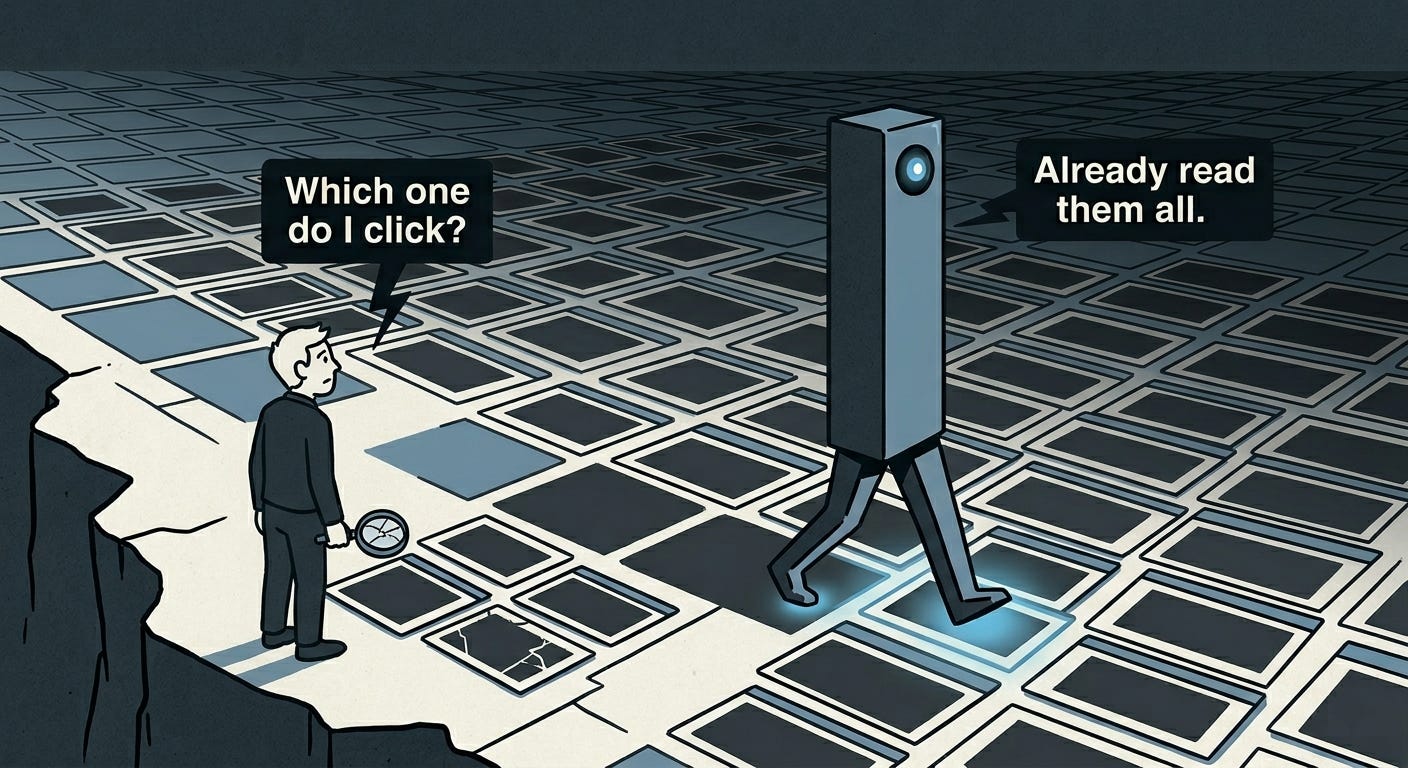
The Shift
Every time someone types a question into an AI chat instead of a search engine, they are not just choosing a different tool, but abandoning a decades-old habit: search, open, read, compare, repeat. That loop, which built the modern web, is breaking. ChatGPT started it, and now Google, the by-far dominant search engine, is following with its AI Mode. The direction is irreversible: AI chat is becoming the default way people retrieve information, and the traditional search engine is scrambling to catch up with its own disruption.
The reason is not intelligence, but efficiency. When you ask it a question, it reaches across dozens of sources, synthesizes the relevant parts, and hands you an answer. The cognitive load the old web placed on users is absorbed by the machine. You get a better answer without ever opening a webpage. And once you experience that, going back feels like doing your own plumbing.
The Last Visit
AI wins on efficiency, but that does not mean the human web goes dark overnight. People still visit websites, for now. When the stakes are high enough, or the source unfamiliar enough, there is still an instinct to check the original content and verify. But as AI systems become more accurate, more cited, and more trusted, even that instinct will erode.
Content that depends on sight, sound, or touch will hold longer. You cannot verify a fit without seeing the jacket. You cannot watch a film in text. But these are delays, not exemptions. The same synthesis AI now applies to text will eventually apply to video: a system that watches a hundred product reviews and generates one composite summary is not science fiction. It is the next step in the same logic.
The Optimization Reversal
If humans are no longer the primary audience for websites, the entire logic of web publishing inverts. For two decades, companies have spent enormous resources making their websites beautiful, navigable, and accessible to human eyes. That investment is about to lose its justification.
What replaces it is optimization for AI retrieval. Structured, machine-readable formats (e.g., Markdown, JSON, YAML) are far more efficient for AI ingestion than visually designed pages built for human comprehension. The vendor who figures out that a clean, structured data feed gets surfaced more frequently in AI-generated summaries than a polished webpage will quietly dismantle their design team and restructure their entire web presence around legibility for AI, not humans.
This is already underway. LLMs have already consumed most of the public web. The transition is accelerating, and at the current pace, we will start seeing its effects within three years, perhaps sooner.
The Wreckage for Tech Jobs
The casualties will be significant. Web designers are the obvious first wave, but the disruption goes deeper. Frontend developers, whose entire craft is rendering information beautifully for human screens, lose their core purpose when humans stop looking. Backend developers, who build the systems that power human-facing applications, face a similar reckoning as complex web architectures give way to structured data endpoints optimized for AI consumption. These are among the largest categories of employment in the technology industry. The shift in the web’s optimization logic may be one of the largest structural changes in the labor market; nonetheless, nobody is talking about it yet.
Who Fills the Visual Gap
If websites stop being designed for humans, someone still has to present information in a way humans can absorb. That responsibility shifts to the AI platforms themselves (e.g., OpenAI, Anthropic, Google) who will increasingly generate visual outputs dynamically, on demand, tailored to each query.
This solves a problem that has plagued web design since the beginning: there is no single visualization that satisfies everyone. A dynamically generated interface can remember that you prefer dense information over white space, tables over bullet points, and adjust accordingly. The difficulty of design was always a preference problem. That problem disappears.
The Brand Layer
Companies, however, still care about identity. Even if they no longer control how their content is displayed, they will not surrender their logo, their slogan, or their visual presence. What emerges is a new business model: companies pay AI platforms to ensure their brand assets surface alongside AI-generated summaries of their content. The economics shift from buying traffic through search engine optimization to buying presence within AI responses, a kind of sponsored identity layer embedded in the AI output itself.
It is not so different from what companies already do when they pay for branded content or sponsored placements. The channel changes, but the instinct to own the frame around your product does not.
What Replaces the Web
The direction is the same across all of them. The website, as we know it, is becoming an artifact. Not immediately, and not without a messy transition. But its trajectory is clear: from destination to data source. From something humans browse to something AI reads.
What replaces it is not a better website. It is an AI that knows what you need, remembers how you like to see it, and generates the right answer without asking you to do any of the work. The only design that matters going forward is the AI’s ability to render understanding on demand. Everything else is just structured data, waiting to be called upon.
The browser tab is not dead yet. But it has stopped growing. And in technology, that is usually how endings begin.
The accompanying podcast represents an AI-generated dialogue produced by Google NotebookLM from this article without editorial direction. While intended as an objective analysis, the synthesized discussion may present perspectives or conclusions that do not necessarily reflect the author’s views. The banner image was created by ChatGPT.

